


Showing posts with label Sustainability. Show all posts
Showing posts with label Sustainability. Show all posts
Project: Solar Lamp
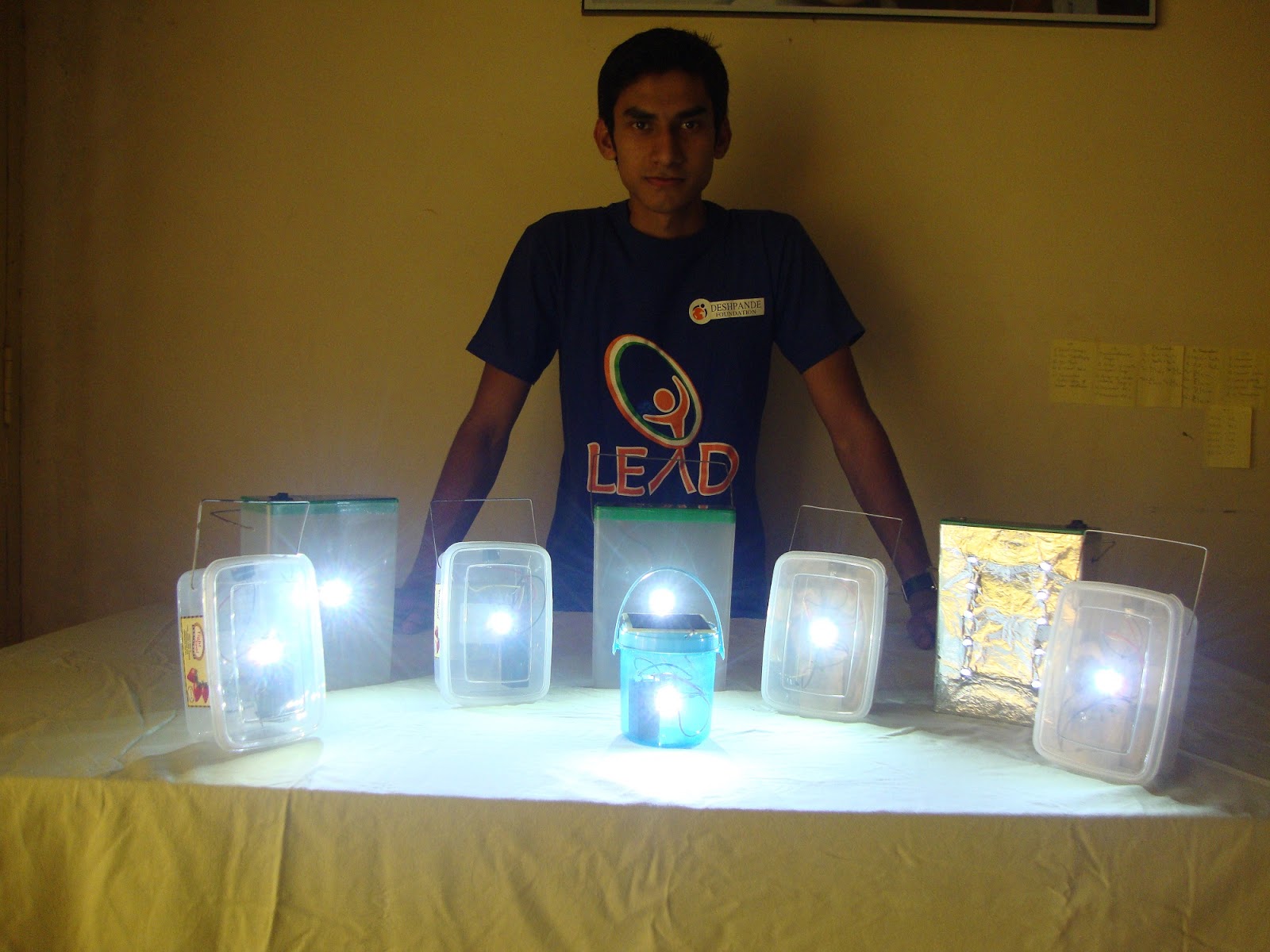
Omkar Tarle (KLECET)
People in the village of Benali suffered from frequent power outages and therefore had little electricity to supply their homes. So, Omkar designed a solar powered lamp, which provides free light source to people affected by the power outages. The construction of the lamp was quite an undertaking-material had to be gathered from Belgaum as well as from Bangalore. Omkar distributed 20 solar lamps, and 150 people are benefitting from these lamps.

Project: Seeds for Life
.JPG)
Sandesh Bhat (MES College of Commerce, Sirsi)
Sandesh identified major agricultural issues: there existed a scarcity in desi rice seeds, and farmers were not receiving proper guidance. After identifying these issues, Sandesh took action. He informed several local NGOs about the problem and and collaborated with the NGOs to hold a workshop for local farmers that would teach them how to conserve seeds. The workshop was facitliated by Kerya Guda and attracted 100 farmers. During the workshop, farmers not only learned better farming techniques, but they were also given the opportunity to exchange ideas with each other. Sandesh’s project only cost Rs 3000, but the impact he created on these farmers’ lives has no value.
.JPG)
Project: Recycling of Waste Chalk
 Atheeq MD (REC Hulkoti)
Atheeq noticed that a lot of chalk was being wasted at his college. He came up with an idea to recycle and reuse the wasted chalk. Atheeq devised a method to recycle use chalk, and he presented this method to the principal. After this method was successfully implemented at his college, he introduced his idea and implemented his method in a local government school.
Project: Automatic Operated Water Pump
LEADer: Nitinkumar Meghannavar
College: KLS
Gogte Institute of Technology, Belgaum
Water plays a key role in human
life. In some areas, water get wasted from overflow of the overhead tank. This depleted both the water resource as well as energy resource. To overcome this the team made an attempt to conserve the resources. It is most useful for people of the
house, who face problems in switching on/off the pump at regular intervals of
time. The water pump can be installed in old age homes, hospitals, hotels, hostel, and
colleges. The team started the project with a proper
plan, sketch of the equipment and the list of raw materials required.
Convincing the residents of the house was a difficult task but after explaining
the importance of the project, they gave their support. The purchase of materials,
machining of materials and assembly were some of the activities done. But the
main problem was the switch (one of the part of equipment), which the team was not able to
find one that is suitable. To overcome this Nitinkumar and his team designed their own model and it worked, then after the installation of the equipment, they demonstrated it to
the residents. The moment when the pump automatically turrned off, everyone present
there was surprised and happy. They congratulated the team for their work. After the completion of this
project many of the team's neighbours and friends were
interested and ready to install it. As of now the team has seven orders from
places including Chikodi, Dandeli and Sulebhavi.


Project: Generation of Electricity from Cow Urine
LEADer: Prabhudev
Team Members: Shridhar Hallikeri, Raghvendra Divanji
Location: KLEIT
The team visited a nearby village to know how much urine was wasted and found that 200 litres of urine was wasted each day. They collected urine samples and brought two electrodes, dipping them in beakers containing urine. Connecting the electrodes to the multimeter the team members noted down the voltage reading. After three attempts they were successful in generating the power of about 0.4-0.6 volts, and the team hopes to produce a larger amount of voltage given a large quantity of urine.


Team Members: Shridhar Hallikeri, Raghvendra Divanji
Location: KLEIT
The team visited a nearby village to know how much urine was wasted and found that 200 litres of urine was wasted each day. They collected urine samples and brought two electrodes, dipping them in beakers containing urine. Connecting the electrodes to the multimeter the team members noted down the voltage reading. After three attempts they were successful in generating the power of about 0.4-0.6 volts, and the team hopes to produce a larger amount of voltage given a large quantity of urine.
The main objective of the project is to provide the rural area people
with proper electricity facility, and also to bring the awareness about the
proper utilization of the naturally available urine in the rural area. The
project has been done on the small scale and was able to generate 0.6 volts
from a half litre urine.
Prabhudev: "If considered on the large scale ...the day isn't far when we find no houses without electricity in the rural areas. Thanks to all my team members and my sir Dr.Nagaraj Shetti for his guidance."


Subscribe to:
Posts (Atom)


