


Showing posts with label Varanasi. Show all posts
Showing posts with label Varanasi. Show all posts
LEAD Valedictory 2016 - Varanasi
 |
| Special guest Mr. Nasib Bamal visiting project showcase |
The event was organized to appreciate and award the college youth for their leadership initiatives that they took to solve the problems of the local community.
College youth and faculties based at Varanasi and surrounding participated to witness the exhibition of top 25 leadership projects and awards to the best leaders.
The guests of honour of the event were Wing Commander Mr. Nasib Bamal (Commanding Officer, 7UP Air Sqn BHU, VNS), Dr. P.K. Mishra (HoD, Chemical Engg. Dept. & Coordinator TBI, IIT BHU), Dr. P.K. Sharma (Program Coordinator, NSS BHU), and Mr. Ajay Suman Shukla (Functional Head, LEAD, Deshpande Foundation).
Out of 108 leaders who successfully executed their ideas into action as leadership projects, 7 leaders were appreciated for the remarkable leadership work that they have done to bring a positive change in the society.
 |
| Shabnam and Amrita receiving Best Leader Award |
 |
| Arya Roshan receiving Master Leader designation |
Awarded leaders include;
- Leaders Rishu Kumar and team (BHU) - Best Team Award for executing 10 leadership projects in the team of 12 members
- Leader Priyanka Srivastav (Rajkiya Mahila Mahavidyalay, DLW) - Most Female Empowerment Initiatives Award. She executed 9 leadership projects along with her friend Susheela to solve the problems of DLW surrounding community. Read more about one of Priyanka's projects here.
- Master Leader Uttam Dixit (BHU) - Best Leader Award for bringing tech solutions in promoting the education and ensuring 500 meters of road construction by motivating and ensuring the use of allotted fund to the village panchayat at Susuwahi. Read more one of Uttam's projects here.
- Leader Dharmendra Patel (BHU) - Best LEADer and Best Project Awards for executing four leadership projects (helped 150 people to get the Aadhar Card, helped 250+ villagers to get the ration card without any extra fee, helping 118 village women and youth to open their bank accounts in UBI). Read more about the projects here.
- Leader Anand Krishna (DAV College) - Most Daring Leadership Project Award for initiating and executing the project in four district jails to teach the kids below 6 years who live along with their mothers within the jail premises, executed same project for bricks Klein (Bhatta) workers' kids. Read more about the project here.
- Leaders Shabnam and Amrita (ABRPG College, Anpara, Sonbhadra) - Best Leader Award for raising the funds and cloths from the localities and helping the 100+ people living on the roads and in slum in winter season.
Four leaders were promoted to Master Leader to further enhance their leadership skills and spread to word about LEAD on their college campuses. The new Master LEADers for 2016/2017 are Uttam Dixit (FoSc. BHU), Dharmendra Patel (FoA, BHU), Arya Roshan (SHEPA College), and Priyanka Dey (VKM, BHU).
As the theme of the event was "Recognizing the Unrecognized", LEAD also recognized a woman in the community whose valuable work goes unseen. Special guest SurShakti cooks the midday meal and cleans the campus at a local primary school, all while raising her family on her own. This act is a continuation of the successful International Women's Day project taken on by LEADers across the country.
 |
| Ms. SurShakti receiving recognition |
My Story: Arpit Srivastava
MY STORY: Arpit Srivastava, Amity University Uttar Pradesh

“The will to win, the desire to succeed, the urge to reach your full potential... these are the keys that will unlock the door to personal excellence.”
In this context, I, LEADer ARPIT SRIVASTAVA, from spiritual city Varanasi, will present my leadership story. It’s a phenomenal fact that behind any positive implementation there are nurtured ideas whose existence defines valuable humanity. For me the biggest challenge was my attributes, as I don’t know about my internal properties and in consequences. Every time I feel myself weak in different field like communications or academics, I saw myself as just an average which forces me to feel as a failure and lose my self identity.
But, by joining LEAD program after an orientation at IIT-BHU, I got courage and confidence and I realized that I do have many choices; many doors are now also open for me in form of opportunities. Thus I took a valuable decision for myself and I have done two projects “SAMANVAY” & “VRIKSHAROPAN”.
 |
| Vriksharopan project |
“VRIKSHAROPAN” is near to my heart as I feel direct connect with nature. I used waste materials like large drums and containers which were in stores in a useless way. Thus, I took an initiative to give identity to those useless non living materials to protect living beings. I planted many plants in those waste materials and I also used my roof area to plant small herbs and vegetables like coriander leaves, tulsi, garlic, chilli, lemon, tomato, beans, and aloe vera. I this way I am contributing my efforts in protecting the environment and nature, and I think that our society will also look forward in contribution on their own level and can help in conserving nature in a sustainable way. “Everything present on this Earth has its own identity, it’s just a way of perception”; which gives me enough strength to prove that I do have potential to make things alive.
 |
| Playing with slum children in Varanasi |
As an Social Media Intern with LEAD, I also got to observe things which were new for me from all the four sides. It has given me an innovative experience; forces me to think from all the sides.Thus for me as an Intern I do realize that both quality & quantity were necessary to exemplify the attributes. So now I know my attributes, now I know how I can evaluate myself; to implement positive ideas for society, by society and to society.
 |
| Winning my award for "BioDex" |
Being a LEADer & an entrepreneur, as well as a LEAD intern, I am using my academic & social strength for the betterment of society & “what was my weakness, today that is my strength”. The outcome is now positive for me; it teaches me that how to inculcate, evaluate myself on a socio-technical platform, it teaches me how to explain my views in a professional way. LEAD, not only gives me a platform but also it gave me an identity which cannot be earn by other means.
”If nature exists, then only we exists”.
Village in the Digital Age by LEADer Dharmendra K
 LEADer Dharmendra Kumar Patel from BHU wanted to help his village gain their basic needs in the modern age. With new requirements from the government but barriers to the villagers obtaining these requirements, Dharmendra realized that many of the villagers would be unable to receive subsidy or rations.
Dharmendra took on three projects in his village: bank account set-ups, AADHAAR identity card sign-up, and ration card sign-up. Together, he felt these basic needs would help the people in his village have their presence recognized in the modern age. These projects also helped build basic modern skills in the village, including ATM use, making signatures,awareness of financial saving, and interacting with large modern establishments such as banks.
At first, only a few villagers were willing to take part in the process and many were hesitant for change. However, now those initial participants have told their neighbours and people are regularly approaching Dharmendra to take part and get a card and bank account. Women are coming out of their homes to sign up and join the modern age.

While Dharmendra has three specific projects, overall he is aiming to increase the wellbeing in his village. A good example of this is his motivation of a disabled woman. She had lost a leg in an accident, and was simply sitting around all day, although he had 3 children to feed. Dharmendra motivated her to learn the basic skill of sleeving to create an income, and after she had a small amount of earnings, got her to take part in his projects. Today, she has 4,500 Rs. in the bank account he helped her create, and she owns her own sleeving machine.
My Story: Arya Roshan
My Story: Arya Roshan, SHEPA Varanasi

My name is Arya Roshan, and I'm a BBA student from SHEPA College Varanasi, My father is a teacher, and since I was a child, I wanted to make the change in the society in a positive way like my father.
However, I needed some support, then my classmate Abhishek told me about LEAD and LEAD provide me that platform.
I joined LEAD in March 2015, and I have participated in many projects as like Ganga cleaning, women appreciation, Nukkad Drama. From these projects I learned that you can make a change in society, even at little-to-no cost. I no longer feel like the only person who wants to make change: i am surrounded by other students who have the same goals and support me, and who have become great friends to me.
 |
| Volunteering for a celebration project in the slum area |
My individual project is "Signature Complain". The idea of this project came from a Adhar Card Camp, where people who work in the camp were misbehaving with the illiterate people because they didn't know how to do a signature and fill forms. I was also inspired by the work of another LEADer, because in his project many of the villagers were having to learn a signature in order to sign up for a bank account for his project. Then I realized that I must teach them to signature. I went to my papa and asked to him about the easy way to teach signature.
 |
| Teaching the signature |
When I went in a village for starting the project, I faced many problems. No one was coming forward to learn signature, but at that time, an old lady came forward and told me that she wanted to go to school but there was some problems she had, so she didn't go to school. She was the first lady who learned to doing signature from me, and now I have taught 94 people how to do signature... this project and each and every project make me happy.
In 2015, I went to Hubballi for LEAD Leadership Program (LLP) and I met so many different kinds of people and made friends of all kinds: different areas, different languages, different interests. I also met many inspiring role models and improved my leadership skills so much in just 10 short days.
LEAD transform me from a shy student to a LEADer and gave me a LEADership qualities. I met many fellow LEADers who I have learned from, and many LEAD staff members who have taught me excellent skills.
"You can change the world if you care enough"
My Story: Aaliza Naseem
My Story: Aaliza Naseem, SHEPA Varanasi

Ever since I was a child, I had been interested in social causes. My mother and I would take old clothing or food to the slum areas to distribute, and I learned how important this was. However, as I grew older, my hesitation and shyness stopped me from going out in the community to do social work. I could barely speak in my own classroom or at a party!
I was intrigued by a LEAD orientation at my college because it spoke about developing your own personality and self-improvement, all while contributing to society. This is exactly what I felt I needed.
The first thing I did when I joined LEAD was take part in a old clothing distribution group project, however, I learned quickly that this was not the same as donating our family's old clothing to the slums with my mother. I had to interact with the public, asking for donations of old clothing and trying to convince them. I also learned to work in a team; we struggled with coordination and timing, but after pushing through, we worked effectively and efficiently as a team and it was a successful project. I learned something very important: you need a team to succeed.
 |
| Volunteering at an old age home |
By volunteering in the projects of others, I have been able to contribute to more causes and build my skills more. two of my favourite projects to help with were providing protective plastic to roadside vendors to increase hygiene, and installing dustbins in the community.
My main project as a part of LEAD has been adopting an orphanage in Ramnager. I have focused almost all my efforts on that one orphanage for over 6 months already, doing many projects with them and benefitting them. Since it is my local orphanage, I saw the terrible conditions of the children there, and noticed how dependent all the children were. I wanted to make their lives better and give them a brighter future. While it was difficult to convince the orphanage owners to trust me and my team, we proved ourselves by working, at first, in front of them so they could see our project and our good intentions. This is also where being part of the LEAD organization helped, because it built our credibility.
 |
| Working with Agastya Foundation at the orphanage |
So far, I have donated hygiene products, done learning and science workshops and creativity sessions, and celebrated several festivals with the orphan children. However, in this project I have, over time, built a team of 9 LEAD students who work in my project. This is my first real leadership role, and while i was initially nervous, I have learned to become a more confident leader and increased my communication skills. I speak personally to each team member, making sure I understand what they want and how they want to help.
Next for the orphanage project I hope to build connections between the orphanage and the local shopkeepers, and have the orphans make paper bags to sell to the shops. This would allow the orphans to make a small income, and because I hope to set up bank accounts for each one, this would help them gain more independence over time.
I also got the chance to take part in LEAD Leadership Program (LLP) 2015 in Hubballi, Karnataka. Before LLP I didnt even ask question in my college class, but there I gained the confidence and developed my identity. I lowered my stage fright, and am now able to give presentations in my college classes, be a better and more confident leader, and be more social.
 |
| On stage at LLP! Getting over my stage fright and increasing my confidence |
When I was promoted to Master LEADer, the first in Uttar Pradesh, I was so excited to share. I have seen the changes in myself that LEAD has helped to cause, and my parents are also so proud. I am able to express myself!
My Story: Priyanka Dey
My Story: Priyanka Dey, BHU

I had always wanted to make a difference, but I just didn't know how to take the first steps. This is why, when I saw a LEAD Orientation at my college, I was so inspired to join. I saw the pictures of the LEADers having fun and making a difference, and I thought, if they can do it, why can't I? I also saw how many of the young students were meeting such inspirational and iconic role models, and I wanted that chance as well.
When I first joined LEAD, I knew I wanted to make a difference, but didn't know exactly what to do. So first, I realized I had to establish what the need was. I looked to other LEAD projects for inspiration, and thought about all the possible people in the world who could use help.
Then, one day, I was crossing the street in Varanasi, and a feeling came over me that this area, one particular slum, was the area I wanted to contribute to. I saw the bad conditions of the children, siting around playing cards and chewing paan rather than in school, and saw how dire the living conditions were. But how could I help them?
I decided to conduct a survey of the area to figure out what their needs were. I made a team of friends and fellow LEADers, and went door-to-door in the slum area, gathering information about the people in the slum, including their professions, how many children there were and if they were in school, and what problems they faced in their lives. From this, I realized that many of the children were not regularly attending classes and did not have any interest, and the parents did not encourage them to learn. For this reason, I decided to create an education project for the approx. 80 children in the slum community. While many of the students agreed to attend the program, they did not seem enthusiastic, and this motivated me to help awaken their interest in education, which is where the name of my project came from, "Awakening Education".
At first, I thought to hold my program in the park behind the slum. However, due to personal safety concerns, I realized this was not a good idea. After explaining the issue, one community member agreed to arrange a room for me and my team to teach in, but when he did not follow through, we were left again with no space. But then the family of several of the prospective students offered their roof as a teaching space. I took this as a good sign; someone so poor was being so generous as to let me, a stranger, use their home for my project.
 |
| With some of the students of "Awakening Education" |
My team and I started teaching each weekday evening from 4:30 to 6, plus we would do a fun activity with the children on Sundays, such as chowing a movie on our laptops, games, or a painting competition we once organized. But after a few months, we realized we needed a real formal space to teach in. Several of us went to speak to government schools, and while they all appreciated our work, the firts two schools refused. After much deliberation, the third school agreed to let us run their program in the school, giving us the keys to the government school. This was a huge moment of pride.
After months of doing my "Awakening Education" project, I was accepted into LEAD Prayana and got the chance to travel around Karnataka with 130 other amazing LEADers. I met amazing role models like I had seen in the orientation, and it was even better than I imagined. A quote from organic farmer Narayan Reddy sir, "simple living, high thinking", was incredibly inspiring for me. IAS officer Mannivannan displayed such amazing speaking skills and showed me someone doing amazing work for his country, standing up to corruption, with little recognition. And Malathi Holla mam, the acclaimed para-athlete, was so motivational in sharing how passion and devotion can lead us to reaching all our dreams.
 |
| Selfies with role model Anousheh Ansari at LEAD Prayana |
At the end of Prayana was Yuva Summit, and it was at this award ceremony that I won a Best LEADer Award 2016. I was shocked. My name was the last of the seven winners to be called, and after hearing the caliber of the other projects, I never imagined I would win. When my name was called, the last LEAD award of the night, it was such a great moment and I became overwhelmed with emotion, accepting my award from such great dignitaries on stage.
 |
| Accepting my Best LEADer Award 2016 from the legends at Yuva Summit |
When I returned to Varanasi, I found myself surrounded by support. Not only were my parents and family so proud that I can been recognized so greatly at such an early age, but the principal of my college asked to speak to me. I had never met her before, and I felt very proud. My friends had not known I was on Prayana and thought I was at home, so when I came back and had met the role models and won an award, they were so surprised!
In March 2016, I got the chance to be a part of the "Recognizing the Unrecognized Women" on International Women's Day. I organized an event for the mothers of the students in my project, and appreciated all the work they do to support their children. I was so glad to be able to appreciate these women who had allowed their children to become educated.
 |
| Recognizing an unrecognized mother on IWD |
I am now motivated to share my story with others, and inspire others to join LEAD. LEAD has helped me to develop my personality, and I hope others take this opportunity as well.
Hygiene for Slum Children by LEADer Amrita Raj
LEADer Amrita Raj from ABR PG College Anpara was concerned about the wellbeing of the slum children in her area. Instead of doing doing, she took action with a LEAD project in order to make a small positive change to give these children closer to the standard of living she had during her upbringing through hygiene kits.
First, Amrita gathered a team and went door-to-door collecting donations from the wealthier areas of her community. While it was difficult to convince people to give them their hard earned money, Amrita focused on explaining why their project mattered to the lives of the slum children and built trust and credibility by explaining about the LEAD program. Eventually, Amrita and her team collected 3500 Rs.
Using old newspapers to create the bags, which lowered the cost and reduced waste, Amrita and her team filled these packages with basic hygiene products for babies and young children, including shampoo, soap, toothbrush, toothpaste, etc.
The team distributed over 150 hygiene packages to young children and mothers with babies in the slum area. For Amrita, the best part was seeing how excited the young children were to receive anything new and just for them, even simple hygiene products.
 |
| Collecting funds door-to-door |
 |
| Amrita and the team making the bags |
The team distributed over 150 hygiene packages to young children and mothers with babies in the slum area. For Amrita, the best part was seeing how excited the young children were to receive anything new and just for them, even simple hygiene products.
Cheap LED Lights with LEADer Uttam D
 Thanks to an long-term interest in electronics, LEADer Uttam D from BHU has designed a very inexpensive LED light to be used in villages.
Uttam loves to take electronics apart, and realized he could make his own small light from old electronics parts for very cheap. At first, the light only lasted for 2-3 minutes, but with the addition of a diode, the simple light is rechargeable and lasts over 6 hours per charge. Rather than using all new parts, the light uses parts from waste phones, including the chargers and batteries. This means that the product can be made cheaper, but it also better for the environment.
So far, Uttam has sold over 50 of the LED lights to individuals in his village and nearby villages for 25 rupees each, earning a small profit of 5 rupees for future supplies. In Varanasi there is a proven market for Jugaad innovations, and therefore Uttam is capitalizing on this openness to small, inexpensive, “homemade” products. He is now trying to commercialize his LED lights.

Don't Smoke! with LEADer Tara M
 LEADer Tara M from ABR PG College (Anpara) understands the many negative effects of smoking, but was concerned that many members of her community did not. She felt compelled to educate them about the many reasons they should not smoke or use tobacco products, including raised blood pressure, increased chance of macular degeneration and stroke, and negative impacts on the lungs, heart, mouth, and throat.
Tara and her group visited the slum areas, where they though awareness about the dangers of smoking would be the lowest. Armed with signs and knowledge, they stopped people in the streets and visited homes to relay their message of health.
 Out in the community, there was two highlights. One man, after the LEADers explained the dangers and pointed out the notice on his tobacco pack that "smoking is injurious to health, tore his packet of tobacco in half and said he would never touch tobacco again. Another women, after speaking with the LEADers, asked for forgiveness and promised to live free of tobacco and alcohol.
Tara considers this project only the first step in her motivations to "stop all the nonsense" and work together "towards a day when there is no alcohol, smoking, or tobacco factories".

International Womens Day 2016: "Recognizing the Unrecognized"
Women work without a break for their families, society, and friends all through the year. So, on IWD 2016, LEAD conducted their 3rd annual "Recognizing the Unrecognized", where women in our society who are rarely recognized but are responsible for important work were recognized for their contributions, such as cleaning railway stations, bus stands, picking household trash, selling vegetables etc. LEAD and LEADers believe that, without these women, our communities would come to a standstill.
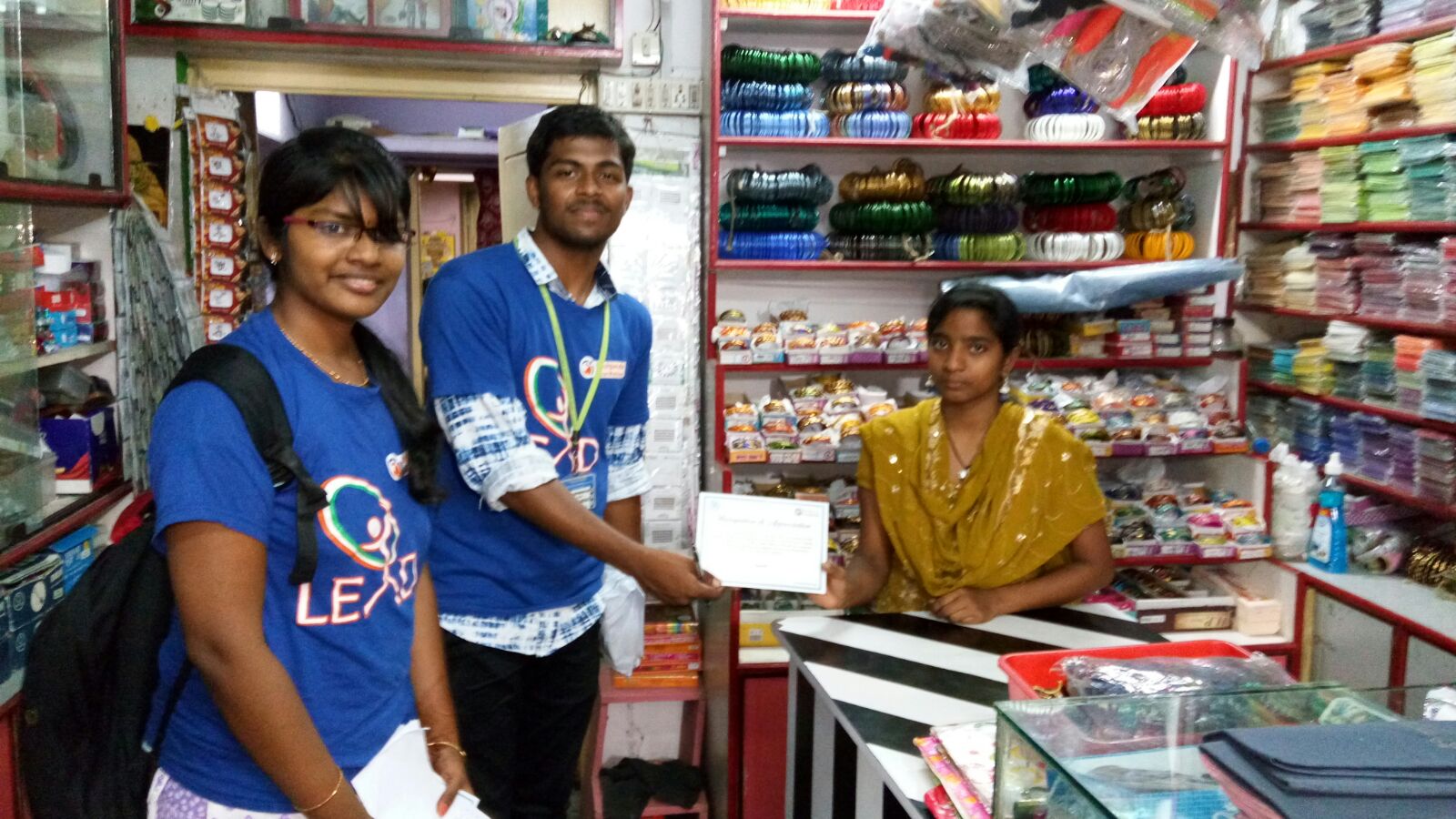
LEADers from each location of LEAD voluntarily took up the initiative to identify and appreciate these women on the occasion of International Women’s Day. After identifying these unrecognized women in their communities, the LEADers made personal visits to their homes and workplaces to thank them for their contributions and presented a certificate of gratitude they personally signed.
In total, 347 students recognized 30,245 women in honour of International Women’s Day, thanking them for their contributions to society that otherwise go unnoticed. AMAZING work by our LEADers!
Students noted that this project helped them improve their communication skills and confidence, as each LEADer approached and spoke to hundreds of women from all different professions, backgrounds, statuses, and levels of education.
 |
| LEADers from Hubballi Sandbox recognizing local security women |
 |
| LEADer from Ek Soch Sandbox (Varanasi) and LEAD Functional Head Ajay Suman Shukla recognizing a working mother |
 |
| LEADers from Kakatiya Sandbox (Nizamabad) recognizing a local shopkeeper |
Changing Children's Mindsets with LEADer Priyanka S
LEADer Priyanka S from Rajkiye Mahila Mahavidalaya College, Varanasi, always considered herself a simple girl, but through her projects in LEAD, is now proud to be a leader. This transformation started from her very first project in LEAD, Sarva Siksha Abhiyan.
 |
| Priyanka with some of the children at a session |
Priyanka noticed that many of the children in her community lacked the basic knowledge, common sense, and morals that were expected of children when she grew up. Instead of sitting idley by, Priyanka took the LEAD slogan to heart: “Complaints start with they… solutions start with I”.
Priyanka contacted all the families in her community, and ended up gathering over 80 students for several educational sessions over the period of one month. At these sessions, Priyanka focused on teaching the basic knowledge and morality through games, and also incorporated her love and gift for dance, singing, and painting to the sessions. It was a rousing success, with the students truly enjoying their time and Priyanka noticing a changing mindset in the young children in her community after the sessions.
While it was a major challenge to convince the parents to bring their children to the sessions, Priyanka’s drive to change the local children helped her push through. In the end, her passion to change the children for the better is something she had in common with the parents, and this why she thinks she succeeded is getting so many children to be a part of her project.
 |
| Some of the children dancing |
Understanding Beggars with LEADer Piyush K
Living in Varanasi, LEADer Piyush from Banaras Hindu University noticed many beggars, both old and young, on the streets, especially in the area of Assi Ghat that he regularly visited. He wondered why it was that these people were begging on the streets… did they have no choice? Why were there people who seems capable of working still begging? What is the future of these beggar children?

For these reasons, Piyush decided to conduct a survey of the beggars to better understand their circumstances so that the problem could be addressed properly in the future. Along with one teammate, he visited six areas where beggars were common and spent time speaking the beggars of all ages. He asked them questions about their family history, how much they make begging, how they feel about being a beggar, what caused them to become a beggar, and whether they had any mental or physical barriers (versus societal barriers) to employment.
It comes as no surprise that this project faced many challenges. Piyush often found it difficult to interact with the beggars; either it was difficult to gain their trust or else they expected something in return for their time answering questions. Several beggars were not just challenging, but rude and abusive. However, Piyush hopes to one day enter into the IS and work in policy, so he knew how important it was to learn to interact with this marginalized group and knew his research would be beneficial.
 Piyush found that there were two primary types of beggars: those begging out of necessity, and professional beggars. Those begging out of necessity were generally individuals who had been forced to leave their native villages and small towns because of industrialization, and when they arrived in Varanasi, were unable to find daily wage employment. Piyush realized that many of the beggar children were in fact the children of these migrant families, as the parents no longer had an income after arriving in the city. On the other hand, some of the elderly beggars were professional beggars, whose families had always begged and therefore they begged as an income source, not because they were unable to work in another industry. Piyush found that some of these elderly beggars in certain spots could beg approximately 400-500 rupees per day, and therefore had no interest in other employment.
Because of his research, Piyush has realized how important it is to address the issues of village people being forced to leave their homes to find work in the cities. If they are unable to find work, they have to resort to begging, which makes them extremely vulnerable to human trafficking because they are visible vulnerable, sitting in the streets, but also do not have many contacts in the city who could help them or know if they were safe. He hopes to apply this understanding when he eventually works in policy making for the IS.
Education for Prisoner's Children with LEADer Anand K
 |
| Anand preparing to enter the prison with school supplies for the children |
LEADer Anand K from BHU has a project that is tackling an issue many of us do not think about: children living in prisons. Along with his brother, fellow LEAD student Shrikant, “Little Krishna” began in order to help these neglected children escape the cycle of poverty, illiteracy, and criminal behaviour. Anand was worried about how if children of the prisoners were not being educated, they would not help India move forward and would likely become criminals themselves.
The first major success of the project came when they were given permission to run their education program in one of the prisons near Varanasi. Prior to their project, no NGO or organizations had been given permission to work in the prison, so this was a huge accomplishment.
First, Anand and Shrikant identified the educated prisoners in the jail to find out who may be able to teach the children on a regular basis. After this, they led a session for the children, parents of children, and the educated prisoners, distributing school supplies and telling about the importance of these children being educated. So far, 3 sessions have been held in the jail, and 2 similar sessions elsewhere: 1 in the slum area, and 1 at the brick-making facility.
 |
| Session with slum children |
Anand found that a serious challenge was that many parents did not want their children educated, because then they are unable to make money for their imprisoned parents. However, this project aims to appeal to their love for their children, encouraging them to understand that education will make a better life for their child later on.
During this project, Anand learned important skills such as how to speak to authority figures and how to motivate. Currently a BA student, Anand hopes to eventually get a job in social work, and believes this project has contributed to him finding this passion and building skills he will need in the future.
Lowering Diabetes with a Plant with LEADers Vinay and Shubham
In India many patients are suffering from diabetes, and every year 10% of diabetes patients in each state are losing their life. The conditions are even worse in that most of the patients can’t afford medicines for cure of this disease. In case of diabetes, the body lost its repairing and healing capacity which is a major threat in this disease. It can be genetic also if proper care has not been maintained.
Observing the worst condition of medical facilities for such a threatening disease, LEADer Shubham with LEADer Vinay Chandra from Varanasi, students of Banaras Hindu University, have taken an incredible initiative for the betterment of patients who are suffering from diabetes. Their interest in medical field inspires them to do for the sake of the patients. They started researching from different resources to look for how they can provide medicines at a low cost and make easily available.
Their continuous effort and research came with an incredible reward as they came to know that a herbal plant “stevia rebaudiana” which can act as a non-caloric natural sweetener... like a blessing from nature for sweetness-loving human beings. These steviosides have a negligible effect on blood glucose, which makes stevia attractive to people on carbohydrate-controlled diets.
 LEADers Shubham and Vinay have shown their active leadership by starting in search of this plant species. They visited many botanical gardens and nurseries and finally they got 50 pieces of this plant species and found a village particularly for this project. There in village they encourage, explain and motivate farmers as well as local people about merits and applications of that plant. Villagers and local people have appreciated this project and supported these leaders in planting of stevia plants and have started crops. They have also planted 60 sets of antioxidant herbal plants (tulsi, neem, lemon, ginger, and garlic) and some flowers-based plants so that it also help farmers to generate income in the off seasons.
“Look deep into nature, and then you will understand everything better”
Albert Einstein
College Health Camp by LEADer Saurabh Singh
LEADer Saurabh Singh from Magadh University in Varanasi is an active, commendable leader. By his projects he proved that an effort can be successful by internal strengths of human being. He organized a health camp in a secondary school “Pragya Vidya Vihar” in Lakhisarai, Bihar. In this 2-day health camp more than 800 students participated, with Saurabh working with school authorities and CMO to help the event be a great success.

A free medical health check-up was organized in the camp in which doctors observed students for personal hygiene, malnutrition, blood pressure and eye checkup. Doctors also guided them in maintaining a proper balance diet. Students were happy to be the part of that health camp; CMO with School authorities had issue a “Health Card” to all participated students and announced that those students will get free health checkup the next year also.
Leader Saurabh has analyzed that in our country, where hospital facilities are very poor, this type of initiative and effort is crucial. School authorities have proved that such health camps are basic necessities now a day. He gained leadership skills through organizing this health camp and he proved that for event planning, team building is necessary. He had raised funds of Rs. 3600/- to organize this event, but observing the efforts of Saurabh, the school and CMO authorities supported him not only in funds but in all areas to help the event run smoothly and successfully.
“It is health that is real wealth and not pieces of gold and silver”
Mahatma Gandhi
Protecting Trees with Rakhis by LEADer Aaliza Naseem

She tied more than 100 rakhis to the trees and more than 50 rakhis were distributed to her villagers to tie on trees in order to save the trees.
 She also tied rakhis on the wrists of police, doctors, and government officers. They were all asking, "why are you doing this?". Aaliza and her team wanted to thank those who still do their duty on the days of the festivals, and wanted to show their appreciation. The team also distributed chocolates to these regarded individuals.
Aaliza and her LEAD team also got a promise from government officials that they will not cut trees, will try save trees and do the plantation. They spread awareness to over 300 people and more than 50 people did tree plantings in their home. She saved more than 150 trees by tying up them with rakhis. The community was very happy and appreciated her initiative.
"I am very thankful for the LEAD platform which has given me an opportunity to utilize my skills for solving social causes. This platform not only helped in building my leadership skills, but also time management, convincing skills, and appreciating team members for their hard work in order to motivate them." She continues to motivate other students to join LEAD program and to take up new challenges.
“Plant a tree, plant a tree, so that next generation can get air for free”.
“One tree can make a million matches; one match can destroy a million trees”.
First Leadership Initiative by BHU Leaders in Ek Soch Sandbox, Varanasi
On the occasion of children’s day, newly joined LEaders Kirti, Pritha, Deepak, Manish and Dheeraj (Faculty of Management & Sciences, Kashi Hindu University) initiated an inspiring first project, touching 600+ students. They organized awareness sessions in schools of Varanasi, namely Glorious Academy and Sunbeam, Bhagwanpur. The LEaders addressed the students in the school assembly, and personally met with them to encourage them to bring a change in society. The emphasis of the encouragement was on cleanliness and hygiene for children of the today and the future, and to start this at a personal level. The schools’ administration were very supportive of the event, and the students showed a great response. As Leader Kirti, Pritha and team notes,
"It was a memorable experience to share. We hope to see a brighter India in the future."


Subscribe to:
Posts (Atom)


