


Showing posts with label KLECET. Show all posts
Showing posts with label KLECET. Show all posts
Belgaum LEADer Provides Clothes for Village Girls in Need
 Belgaum LEADer Zeba Kazi from KLECET wanted to reach out to needy girls in the society. In her project ARK (Act of Random Kindness), she visited nearby villages and identified girls that were especially in need. After getting permission from the local schools, Zeba visited three different villages and played games with the children. She also donated clothes to the girls that she had collected from her own college hostel.
 Zeba comments that this project was a great learning experience for her. Through this initiative, zeba really came to know the kinds of problems that girls are facing in villages. Zeba also encountered many HIV affected girls in this project, and she feels good that she was able to help them.

My Story: Alisha Shiledar (KLECET, Belgaum)
Alisha Shiledar (KLECET, Belgaum)

My LEAD journey began with one little girl named Fatima. Fatima, around 8 years old, desperately wanted to go to school. Her family being poor, though, Fatima had to help her mother every day, who worked as a maid. I would see Fatima every day, and seriously worried about the girl’s condition. I talked to her and made her my friend. Fatima was innocent, but I could see her innocence diminishing. I soon realized that Fatima was not alone, and that there were many other girls in Fatima’s same situation, or worse.
Fatima’s
story inspired my first LEAD project.
I went to the government school near Fatima’s home and learned that most
of the children were only attending school two weeks every month, at the
most. I decided to take action. At first I approached the parents of
the children and tried to explain to them the importance of education, but I was
greeted with opposition.
Many of the parents shouted at me and even slammed the doors in my
face. But I didn’t give up. I couldn’t give up. I then went to the
school. On Saturdays and Sundays
for three months, I volunteered at the school and devised fun ways to teach the
children the basic skills that they were lacking, which also helped generate an
interest for school within the children.
But
ultimately, I knew that helping the children wasn’t enough. I realized that the root of the problem
lay with the parents, and that I would have to convince the parents to let
their children come to school. I
decided to focus on the mothers, and for one month I taught them basic literacy
skills.
Because
of my project, 50 children, including Fatima, are attending school regularly. The
success of this project really improved my confidence. When it happened, I felt so good and
happy. I had no idea my project
would be so successful. 50
children going back to school is a big thing.
Feeling
totally motivated and energized, I completed another project that aimed to improve
the condition of government school children. In my second project, I organized acting, painting, model
making, and singing competitions to showcase children’s talents in two
government schools. The children’s artistic productions were published in local
newspapers.
I
can honestly say that LEAD provoked my inner heart and inspired social
awareness within me. Above all,
though, LEAD challenged me to become an active member of society. I have
started speaking up about issues, which I never used to. I used to hesitate. But now, whenever I feel something is
wrong, I speak up. LEAD has
changed me.
Project: Boiler Manufacturer
 Ajay V. Gokhale (KLECET)
Ajay had the idea to create a boiler manufacturer, which produces enough steam to run a steam engine of 20HP. Ajay's boiler manufacturer can save Rs 60,000 per month in various agricultural areas, which previously had been spent on costly diesel fuel to power diesel engines.


Project: LEAD Library
Santosh G Katral (KLECET)
The village of Honwad did not have a decent library. Santosh wanted to create a library for the villagers, particularly the students, to enhance creativity, education, and provide them a place to study.
Construction of the library started with making a list of requirements and collecting the necessary materials. Santosh and his team approached Shrikant Talakeri, Uttam Katral, Gopal Katral, Anil Natikar, and Prashant Uttare and collected over 400 study materials such as textbooks, exam books, notes, quote books, storybooks, and magazines. Prashant Talakeri, the President of the library, provided space for the library without requiring any rent. Santosh and his team then appointed people for the management positions of the LEAD Library.
The LEAD Library has been very helpful to villagers and students alike in Honwad. Santosh says that the most important lesson he learned from this is that "when major problems arise, we should try to do something different than others."


The village of Honwad did not have a decent library. Santosh wanted to create a library for the villagers, particularly the students, to enhance creativity, education, and provide them a place to study.
Construction of the library started with making a list of requirements and collecting the necessary materials. Santosh and his team approached Shrikant Talakeri, Uttam Katral, Gopal Katral, Anil Natikar, and Prashant Uttare and collected over 400 study materials such as textbooks, exam books, notes, quote books, storybooks, and magazines. Prashant Talakeri, the President of the library, provided space for the library without requiring any rent. Santosh and his team then appointed people for the management positions of the LEAD Library.
The LEAD Library has been very helpful to villagers and students alike in Honwad. Santosh says that the most important lesson he learned from this is that "when major problems arise, we should try to do something different than others."


Project: Fund Collection for HIV Positive Kids
Pallavi Kannur (KLECET)
Pallavi had always wanted to help children with HIV. His LEAD project gave him an opportunity to do just that. He organized a team consisting of 11 members and, one morning in December, they set out towards the city market and collected funds from the public until the evening. While it was sometimes difficult for them to convince people to donate money, Pallavi and his teammates all enjoyed working on the project. Pallavi reflects positively on his LEAD project experience because he feel he has made a difference in the lives of children with HIV, and he is also proud of the personal growth he himself has experienced.


Pallavi had always wanted to help children with HIV. His LEAD project gave him an opportunity to do just that. He organized a team consisting of 11 members and, one morning in December, they set out towards the city market and collected funds from the public until the evening. While it was sometimes difficult for them to convince people to donate money, Pallavi and his teammates all enjoyed working on the project. Pallavi reflects positively on his LEAD project experience because he feel he has made a difference in the lives of children with HIV, and he is also proud of the personal growth he himself has experienced.


Project: Sapathrang
Alisha A Shiledar (KLECET)
Alisha believes that "All children are born with talent, but they can only shine if we help and guide them." Alisha noticed that government school children have a lot of talent, but do not ahve the opportunity to showcase their talents. Alisha wanted to give these students the opportunity to explore their talents, lift their spirits, and encourage them to face their fears.
While the government school children attended weekly art classes, the class structure consisted of simply copying drawings from the teacher. Alisha wanted the children to generate their own ideas and create art from those ideas. To accomplish this, Alisha and her team conducted a two-day art competition for the children. The competition was comprised of drawing, painting, model making, acting, and singing.


Alisha believes that "All children are born with talent, but they can only shine if we help and guide them." Alisha noticed that government school children have a lot of talent, but do not ahve the opportunity to showcase their talents. Alisha wanted to give these students the opportunity to explore their talents, lift their spirits, and encourage them to face their fears.
While the government school children attended weekly art classes, the class structure consisted of simply copying drawings from the teacher. Alisha wanted the children to generate their own ideas and create art from those ideas. To accomplish this, Alisha and her team conducted a two-day art competition for the children. The competition was comprised of drawing, painting, model making, acting, and singing.


Project: Sending the Slum Children Back to School
Alisha A Shiledar (KLECET)
Alisha met a small girl named Usma. Usma used to skip school to help her mother, who worked as a maid, with her work. Alisha asked Usma why she didn't school, and Usma replied that she loves going to school, but she needs to help her mother in order for them to earn their livelihoods. Alisha felt touched by Usma's story, and soon realized that Usma was not child not going to school.
Alisha went to Usma's school and spoke with her teacher to find the root causes behind children not coming to school. She then formed a team and went to Usma's school and tried to enhance the learning environment by playing games with the children and conducting different competitions. Alisha's team also organized a program for the mothers of the children and taught them the importance of education.
While Alisha did face many challenges convincing the parents to keep their children in school, she was able to successfully communicate with them. Now, more than 20 children are attending school regularly.


Alisha met a small girl named Usma. Usma used to skip school to help her mother, who worked as a maid, with her work. Alisha asked Usma why she didn't school, and Usma replied that she loves going to school, but she needs to help her mother in order for them to earn their livelihoods. Alisha felt touched by Usma's story, and soon realized that Usma was not child not going to school.
Alisha went to Usma's school and spoke with her teacher to find the root causes behind children not coming to school. She then formed a team and went to Usma's school and tried to enhance the learning environment by playing games with the children and conducting different competitions. Alisha's team also organized a program for the mothers of the children and taught them the importance of education.
While Alisha did face many challenges convincing the parents to keep their children in school, she was able to successfully communicate with them. Now, more than 20 children are attending school regularly.


Project: Solar Lamp
Omkar Tarle (KLECET)
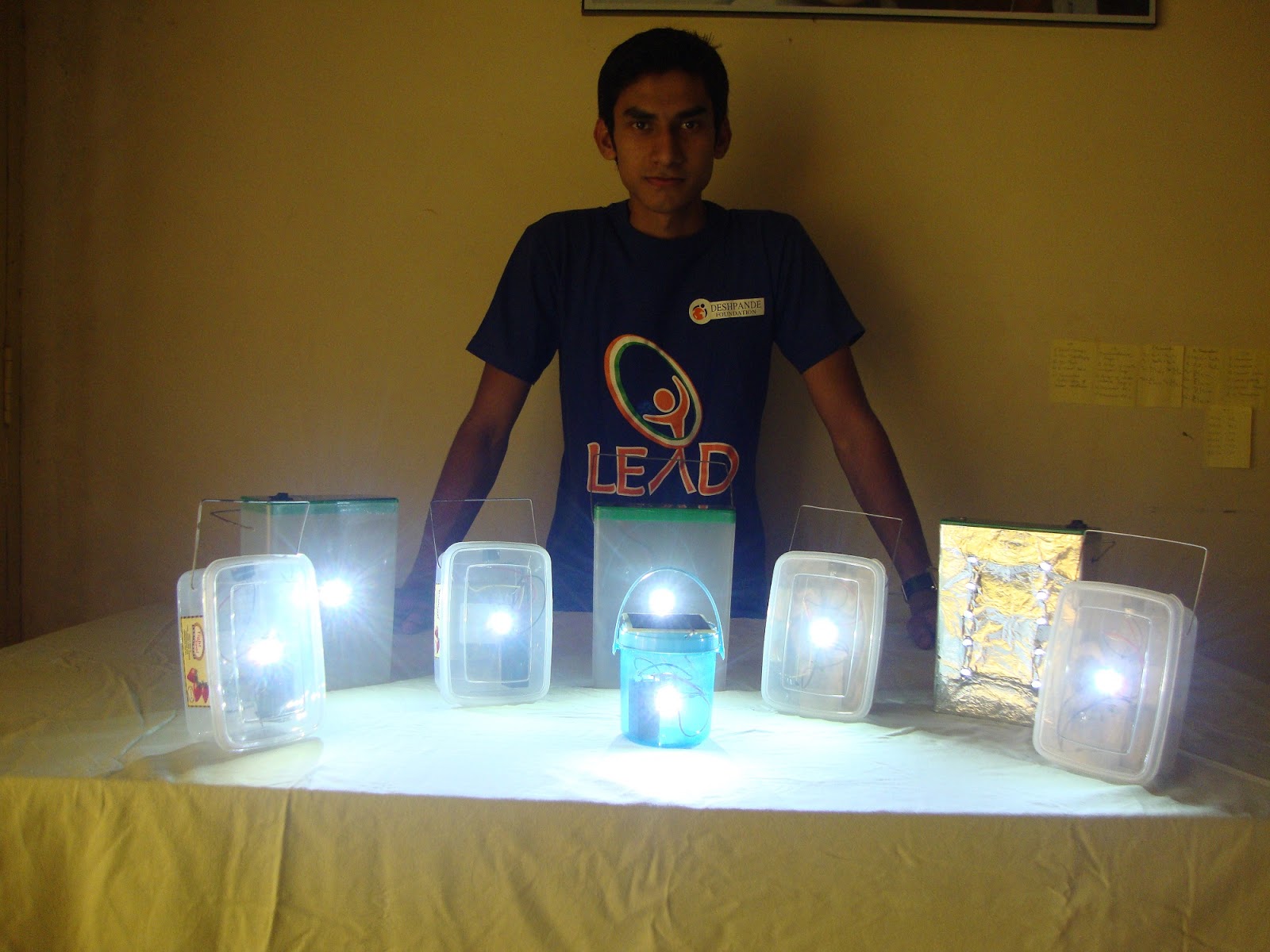
People in the village of Benali suffered from frequent power outages and therefore had little electricity to supply their homes. So, Omkar designed a solar powered lamp, which provides free light source to people affected by the power outages. The construction of the lamp was quite an undertaking-material had to be gathered from Belgaum as well as from Bangalore. Omkar distributed 20 solar lamps, and 150 people are benefitting from these lamps.

Project: Increase Computer Skills in Blind Children
Bipin (KLECET)


While the government has improved facilities for special needs children, Bipin noticed that in Belgaum, school computers were not meeting efficiency standards. Bipin and his team worked hard to raise Rs 14,000 to replace the RAM of the computers. The 250 students of the Maheshwari School for the blind in Belgaum will greatly benefit from Bipin’s project.
Project: Science of Life
Shivanand Patil (KLECET)
In his project, Shivanand taught a practical science experiment to students at a government high school. After teaching the science experiment, Shivanand encouraged the school to hold a separate class for conducting science experiments. His project cost only Rs 1500, but with this money, Shivanand was able to change the school’s curriculum to incorporate more hands-on and practical learning. Because of Shivanand, the students of the high school are receiving a more diverse education.
Project: Masti Ki Paatshala
Prithviraj (KLECET)

Prithviraj began his project with the intention of starting his own school for children who otherwise would not be able to go to school. He took education a step further, though, and organized a group of students to teach classes on computer skills, akshara abyasa, and creativity. In addition to the classes, he facilitated tailoring training for women. Over 100 students benefitted from Prithviraj’s work, 10 women have been trained in tailoring, and school fees were reduced from Rs 400 to Rs 100 per month.

Project: Android Application For LEAD
LEADer: Shivanand Patil
College: KLECET
In this generation many are using smartphones.
The LEADer took up this project so that it becomes easier for people to do
their registration with LEAD, and to send their project proposal and project
completion details through their mobiles instead of going to the website
through the computer every time. It gives every detail of Deshpande Foundation
and shows the recent events conducted by various project leaders and by LEAD.
They can do all this through this application in their mobile wherever they
are.

Project: Solar Lamp
LEADer: Omkar Tarale
College: KLECET Belgaum
The main objective of taking up this project
was to help people suffering from frequent power cuts or have no
electricity supply to their homes by providing free electricity through the
Solar Lamp.


Project: Talents In You
LEADer: Vini J. Kadam
College: KLECET
Vini took this project because all the students
from the government schools cannot take up medical or engineering etc. as their
careers. She took up this project in order to make the students aware of their
talents like singing, drawing, monoacting etc. Hopefully, in the future they
can take up any talents. The challenges which Vini faced during the execution
of project was convincing the principal about the project and conducting the three
competitions in one day with limited durations. By this Vini learnt how to
manage time and to take the right decisions at right time.


Project: Bottle Shoes
 Leader : Ankur Verma
Team: Sourab, Debjyoti and Rakesh
College: KLE CET, Belgaum.
Place of implementation: Khanapur
Date: 7/12/2010

 Having prior experience with Thinkindia and UNICEF, Ankur decided to use this experience in association with LEAD and create a difference in the lives of the people of Khanapur in Belgaum. After speaking to one of his friends, he discovered that few people had shoes in the small village. Ankur decided to make the best use of the available resources and make shoes out of old mineral water bottles. After collecting 40 bottles, Ankur and team made 20 pairs of shoes. They distributed the shoes freely. The cost of making the shoes is minimal since they used nylon threads. The nylon bands are sturdy and do not wear off. Ankur told the people how to make the shoes and showed them how to fill the bottles with cloth for more comfort.
The experience has been good and rewarding. As Ankur wishes to be an entrepreneur, this experience has been an insight.
LEADership Symposium
 |
| Desh interacting with Hubli Leaders |
 |
| LEAD Belgaum faculties with Desh |
 |
Talk on innovation and leadership with faculties
|
Subscribe to:
Comments (Atom)


